

Riders from the Pastures
Machine translation.
This page was machine-translated from Czech. The Czech version is authoritative.
Switch to original Czech version. · Zobrazit originál článku v češtině
From Korea to Poland, a steppe stretches almost without interruption across the continent, inhabited since antiquity by nomadic pastoral tribes with a similar, almost identical way of life. These nomads run through the whole of history and, as feared warriors, set entire nations in motion. Their main weapons are small, hardy horses, which give them mobility, the short bow and the spear.
Essentially, there were three large groups: the Indo-Iranian peoples, the Turks and the Mongols. Ancient civilisations came into contact with the Iranian tribes, the Scythians and Sarmatians, who were often hired as excellent archers. In the first centuries AD, however, they succumbed to a far more aggressive group of Turkic-Mongol tribes. The Chinese called them the Hsiung-nu; we know them as the Huns, Avars, Magyars, Bulgars, Khazars, Uzbeks, Pechenegs, Seljuks, Ottomans, Kipchaks and others.
All of them were masters of a fearsomely effective weapon – the short horse bow. This groundbreaking invention of the steppe nomads combined the excellent properties of various materials and, thanks to its special shape, surpassed simple bows in efficiency and durability. Because of its small size (it could be shorter than 1 metre), the composite recurve bow did not hinder the rider's movement. Thanks to its pre-tensioning, it gave the arrow a high initial velocity, and its greater elasticity allowed a considerably longer draw length. The construction of this small war machine was ingenious. The body of the bow was made of wood (most often mulberry, ash, birch, maple and bamboo), backed from behind with strips of horn. Almost any horn can be used, most commonly cattle horn pressed in advance with heat, which is very difficult because it grows in a spiral, as well as buffalo and various species of antelope.
Horn is extremely strong under compression (compressibility of up to 4%). Depending on tribal tradition and the material used, either one continuous strip or several thinner ones were applied to each bow limb. On the front, along the whole length of the bow, a continuous band of animal sinew was glued, which withstands a pull of up to 20 kg per square millimetre and gives the bow limbs greater speed. Glue was used as the adhesive, most often fish glue, as it resisted the weather better. Such a bow was already being made at least 1500 years BC.
The siyah levers (also spelled siha), which substantially improve the draw characteristic and lengthen the draw, were probably an innovation of the Huns. They became standard on recurve bows. The horse bow was drawn with the thumb towards the cheek, ear or shoulder, and the arrow was placed on the right side of the bow (which European illustrators usually did not fail to emphasise). This method of drawing allows a faster shot but is more difficult to master than the European three-finger style. The archer also cannot see the point of the arrow, so aiming requires considerable practice.
Whoever managed to build a disciplined army out of such riders was practically unbeatable.
In the 5th century, the Hun Attila achieved this. With a relatively small army of mobile archers, he swept through the whole of Europe and changed its map for ever. With his death, however, the empire also died and the confederation again broke up into small tribes. Nevertheless, their bow became a favourite weapon of the Germanic nobility. Hun is a Mongolian word meaning human being. In 1206 the hunter Temüjin of the Borjigin clan became Genghis Khan. He united the nomadic tribes in the territory of present-day Mongolia – the Keraites, Merkits and other tribes – with whom he conquered China within ten years.
He also tried to establish diplomatic relations with the mighty Khwarazmian Empire, but its shah, Muhammad, took the offer of the desert nomad as an insult and had the envoys executed. He could not imagine that the Mongols would cross the mountains. When he lay dying less than two years later and his empire no longer existed, he could imagine it quite well. Unwittingly, he set the Mongols in motion towards the West. Within 20 years they were in Europe and had sent its knighthood to the scrap heap. Fortunately, Europe unpleasantly surprised them with its poverty, so they did not linger. The Mongol army was not huge.
At the time of Genghis's death the army numbered about 100,000 warriors (they would fit into Wenceslas Square in Prague), but it was perfectly disciplined. One tumen numbered 10,000 warriors, but about 40,000 people and 600,000 animals. The punishments for the slightest offence were very severe. A warrior had five horses, three bows and 60 arrows: 30 light ones for long-range shooting and 30 heavier ones for piercing armour. Losing a bow in battle was punishable by death. After the army passed through there was devastation everywhere – the Mongols knew how to use terror as a weapon – but an unprecedented flourishing followed. Within three generations the borders disappeared from the Caucasus to the China Sea. The Mongols favoured science and trade. They invented hardly anything apart from the cannon, paper money and the solar telegraph, but they subsequently brought about the rise of Russia, China and India and set in motion contact between Europe and the East, which outlived them.
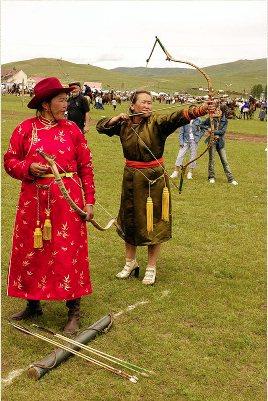
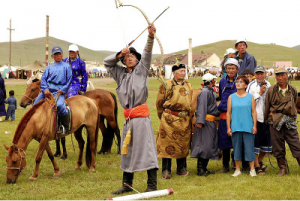
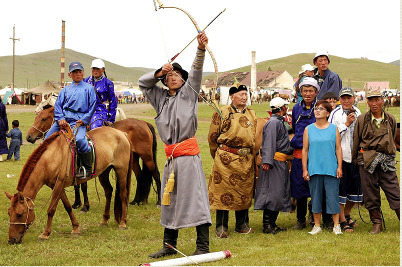
Mongols still practise archery today and regularly compete in it at the traditional Naadam festival. They learn to ride a horse from the age of 3 and to shoot a bow from about 6. Like their ancestors, they use the traditional composite bow and reed or bamboo arrows with long, low fletching. They draw the bowstring with the thumb, but they place the arrow on the left of the bow and aim along the arrow.
Men, women and children compete at this festival in three disciplines: Khalkha, Buryat and Uriankhai.
- In Khalkha, the archer tries to hit a standing target weighing 0.5 kg at 40 metres. After being hit, the target must roll 4 metres and clear an obstacle 20 cm high.
- In Buryat, there is a pit in front of the target and behind it, into which the target must fall.
- Uriankhai is target shooting for men at 75 metres and for women at 65 metres.
Author: Michal Sodja