

Riders of the Pastures
Machine translation.
This page was machine-translated from Czech. The Czech version is authoritative.
Switch to original Czech version. · Zobrazit originál článku v češtině
|
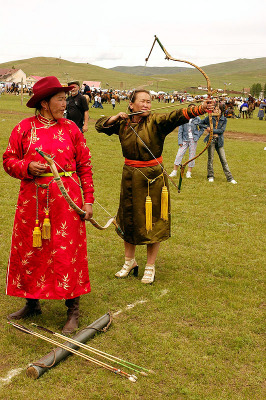
Essentially there were three large groups: the Indo-Iranian, the Turks and the Mongols. Ancient civilisations came into contact with the Iranian tribes, the Scythians and Sarmatians, who were readily hired as excellent archers. In the first centuries AD, however, they succumbed to a far more aggressive group of Turko-Mongol tribes. The Chinese called them the Hsiung-nu; we know them as the Huns, Avars, Magyars, Bulgars, Khazars, Uzbeks, Pechenegs, Seljuks, Ottomans, Kipchaks and others. The siyah levers (also spelt siyah), which considerably improve the draw characteristics and lengthen the draw, were probably an innovation of the Huns. They became standard on recurve bows. The horse bow was drawn with the thumb towards the cheek, ear or shoulder, and the arrow was placed on the right side of the bow (which European illustrators mostly did not fail to emphasise). This method of drawing allows a faster shot, but is harder to master than the European three-finger style. The archer also cannot see the point of the arrow, so aiming requires considerable practice. |
|
In the 5th century the Hun Attila managed it. With a relatively small army of mobile archers he rode across the whole of Europe and changed its map for ever. With his death, however, the empire also died and the union fell apart again into small tribes. Nevertheless, their bow became a favourite weapon of the Germanic nobility. Hun is a Mongolian word meaning human being. In 1206 the hunter Temujin of the Borjigin clan became Genghis Khan. He united the nomadic tribes on the territory of present-day Mongolia – the Keraites, Merkits and other tribes – with whom he conquered China within ten years.
He also tried to establish diplomatic relations with the mighty Khwarezmian empire, but its shah Muhammad took the offer of the desert nomad as an insult and had the envoys executed. He could not imagine that the Mongols would cross the mountains. When he lay dying less than two years later and his empire no longer existed, he could imagine it quite well. Unwittingly he had set the Mongols in motion towards the West. Within 20 years they were in Europe and sent its knights to the scrap heap. Fortunately, Europe unpleasantly surprised them with its poverty, so they did not stay long.
The Mongol army was not huge.
|
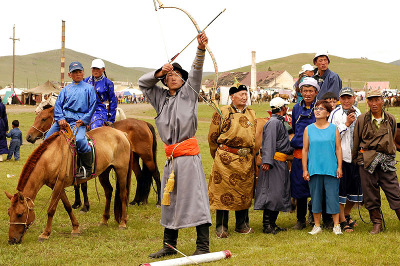
At the time of Genghis's death the army numbered about 100,000 warriors (they would fit into Wenceslas Square in Prague), but it was perfectly disciplined. One tumen numbered 10,000 warriors, but about 40,000 people and 600,000 animals. The penalties for the slightest offence were very severe. A warrior had five horses, three bows and 60 arrows: 30 light ones for long-distance shooting and 30 heavier ones for piercing armour. Losing a bow in battle was punishable by death. After the army had passed, devastation lay everywhere – the Mongols knew how to use terror as a weapon – but an unprecedented flourishing followed. Within three generations the borders disappeared from the Caucasus to the China Sea. The Mongols favoured science and trade. They invented little besides the cannon, paper money and the solar telegraph, but they subsequently caused the emergence of Russia, China and India and set in motion contacts between Europe and the East, which outlived them. The Mongols still practise archery today and regularly measure their strength in it at the traditional Naadam festival. They learn to ride a horse from the age of 3 and to shoot a bow from about the age of 6. Like their ancestors they use a traditional composite bow and reed or bamboo arrows with long, low fletching. They draw the bowstring with the thumb, but they nock the arrow on the left side of the bow and aim along the arrow. |
Men, women and children compete at this festival in three disciplines: Khalkha, Buryat and Uriankhai.
In Khalkha the archer tries to hit a standing target weighing 0.5 kg at 40 metres. After being hit, the target must roll 4 metres and jump over an obstacle 20 cm high. In Buryat there is a pit in front of and behind the target, and the target must fall into it. Uriankhai is target shooting for men at 75 metres and for women at 65 metres.
Author: Michal Sodja
Want to know more?
Then visit the discussion on Lukostrelec.cz titled: "Turkish bows and arrows? What do we know about them?".
If you know any other interesting facts relating to this period of history, do not hesitate to share them with others in the Comments below this article. The most interesting information will subsequently be added to the article. Thank you.