

The late Gothic crossbow and its construction
Machine translation.
This page was machine-translated from Czech. The Czech version is authoritative.
Switch to original Czech version. · Zobrazit originál článku v češtině
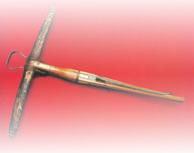 Bows are not the only thing one can shoot with, and there are quite a lot of crossbowmen in the Czech lands too. The following article is intended precisely for fans of this more modern weapon. Its author is Martin "Broďan" Picek – the article is reproduced with the author's kind permission from the website of the Bratrstvo střelcuov miesta Český Brod, of which Broďan is a member.
Introduction
The crossbow, i.e. a mechanical missile weapon with a massive bow set transversely into a stock (the tiller) and a simple trigger mechanism, went through a very long development, and its beginnings can be traced back to about 400 BC in Greece and China. This article covers only a relatively short stretch of its history, when it played an important role in all the conflicts that affected our territory. From the beginning of the 15th century the crossbow (in the language of the period "samostřiel" or "kušě") was essentially the only missile weapon used for military purposes in Bohemia, and the preference for it over the bow must be seen in a wider context.From the 11th century the most important component of a feudal army in Europe was the noble heavy cavalry; medium cavalry played a supplementary role and the infantry, with few exceptions, a rather subordinate one. The proud and self-confident knight expected an equal opponent, with the same equipment and the same style of fighting. For several centuries there was no need to change, in our region, the tactic of two formations of armoured horsemen colliding with each other.
The bow used here in the Middle Ages was not a very powerful weapon, and with the development of protective armour it became ineffective. Gothic paintings show both recurve bows and straight ones (e.g. the Velislav Bible and the Bible of Wenceslas IV). Over the course of the 14th century one can observe a growing numerical superiority of crossbows over bows. By the beginning of the 15th century the bow was already a rather exceptional sight in military equipment. The crossbow had clearly won. It required no special training, was sufficiently effective even against armour, and could be kept spanned and ready for immediate shooting for a long time. Only a small space was needed to operate it, which was an advantage above all in the defence of fortifications.
It is generally known that the Hussite wars brought a fundamental turn in the way battles were fought. Inexperienced and initially poorly armed popular infantry would not have been a serious opponent for heavily armoured men in an open field. It was able to hold its own only thanks to mobile field fortifications – the wagon fort. Since this was in essence a fortress, similar missile and firearm weapons were used for its defence as in towns, castles and strongholds. The towns, which played a key role in the wars of the time, had sufficient craft capacity to equip the army with huge quantities of these weapons, which were demanding to produce. Each war wagon was usually manned by 4–8 crossbowmen, 2 handgunners, 2 pavise-bearers, several flail and pike men and 2 drivers. Mounted shooters were also often armed with crossbows (as an alternative to a firearm).
Construction
The late Gothic crossbow was a relatively perfect weapon. Its composite bow was made using various technologies. Usually several layers of animal sinew (which withstands tension well) were glued to the outer side of a wooden core and horn (which resists compression well) to the inner side. The horn plates were grooved on both sides and glued together with glue. Fish glue, which is more elastic than bone or hide glue, was probably used. The whole was covered with transversely bound hemp cords and wrapped in thin leather (parchment, snakeskin) or linen, or in birch bark. This outer layer was sometimes sewn shut, but sometimes only glued.Some bows had no wooden core at all and consisted only of horn and sinew. In general, it can be said that locally available materials were used to make the bows, and production technologies therefore differed. In our region it is hardly to be assumed that a standard bow contained, for example, whalebone.
A bow constructed in this way was relatively light and therefore absorbed only a small part of the energy put into it for its own acceleration. In terms of the crossbow's efficiency it was thus more advantageous than the later steel bows. Its disadvantages were low resistance to rain and moisture (special transport covers were used) and the long time needed to make it.
The composite bow was fastened to the tiller exclusively by a bundle of cords, usually hemp.
In western Europe the technology for making a steel bow had already been mastered in the 15th century. For it there was an alternative method of attachment using iron stirrups and wedges. In Bohemia the steel bow spread only in the 16th century, i.e. in the Renaissance period.
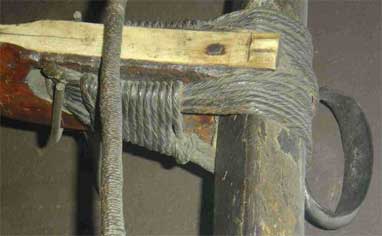 | 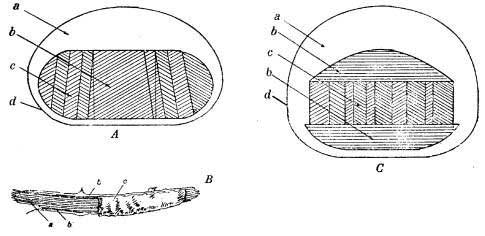 |
| An example of how the bow was lashed to the tiller | Cross-section of a composite bow |
Once spanned, the strong bowstring was caught by the so-called nut, a bone or iron cylinder with cut-outs for the bowstring and the bolt and with a notch to engage the trigger. The nut was seated precisely in the tiller, in a bed reinforced with bone or in an iron housing, against which it rested with its entire front surface when the weapon was spanned. It was therefore enough to tie it to the tiller with string to keep it in place. Animal bone or antler was not a sufficiently durable material for contact with the trigger lever. For that reason a vertical pin was inserted into the nut, holding an iron plate against which the trigger rested. Iron nuts have been used since the 15th century, yet a bone nut still commonly appears in the 16th and 17th centuries too. An iron nut could also be attached to the tiller with a pin-axle, and its exact seating in the stock is not necessary in that case. This solution, however, is a matter of speculation and was used very little in the Middle Ages. The trigger consists of a long lever that either has no spring or rests against a leaf spring. The presence of this spring is required by some types of spanning devices (windlass, German and English cranequin, "goat's foot").
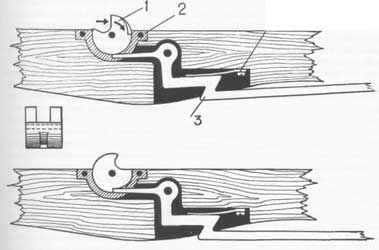 | 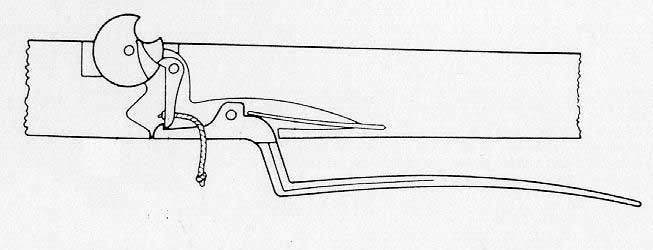 |
| A classic trigger mechanism with a nut seated loosely in a metal housing | A trigger mechanism with a split lever. After each shot the nut catch was returned to its starting position by pulling on a projecting string with a knot |
Spanning the crossbow
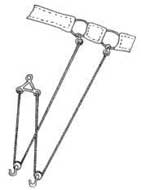
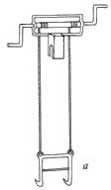
Throughout the late Middle Ages the vast majority of field crossbows were spanned by means of a belt hook, either asymmetrically with a single hook or symmetrically with a double hook (or two small hooks). For this reason a massive stirrup for the shooter's foot is attached to the tiller together with the bow. The shooter fitted the hook, hung on a strong belt, onto the bowstring and spanned the weapon by pressing down with his foot. During spanning the hook was held in place by hand. The draw weight of such crossbows could hardly exceed 1300–1500 N. An ordinary person could no longer cope physically with a heavier draw. At several tens of metres the bolts fired – the so-called "plitky" – could pierce all types of lighter clothing and armour and penetrate sufficiently beyond it. Riveted mail, quilted garments and lighter plate coats could no longer stop the bolt. Plate armour offered good protection, and even when the bolt went through the plate, it did not penetrate very deep. The advantages of these crossbows were a relatively high rate of fire – 2 to 3 aimed shots per minute – and easy handling, which was especially appreciated in a field battle, when the fighter was under considerable stress.The rising quality of armour demanded more powerful crossbows. To span them, either simple windlasses and lever spanners working by pull or push ("goat's foot") were used, or the elaborate English and German cranequins, which were demanding to make. The English cranequin reduced the force needed for spanning by means of several pulleys (2–6) over which ropes wound by a crank were led. The Old Czech term "kliky" was apparently used both for the English cranequin and for a windlass without pulleys. Its disadvantage was the possibility of the long ropes becoming tangled during battle, since after spanning it was removed from the weapon and hung on the belt. The so-called German cranequin (Zahnstangewinde, in Old German Heber or Hebar) can therefore be considered the most perfect spanner. It worked on the principle of a toothed rack with a hook for the bowstring, which was moved by a gear wheel with a pinion and a crank. It could span even the strongest crossbows, with a draw weight of up to 5500 N (this frequently quoted figure, however, apparently relates to later steel bows).
Such weapons pierced even plate field armour at a distance of several tens of metres. Besides slow operation, however, they also had other weaknesses, nowadays overlooked. All parts of the crossbow were under extreme stress (especially the antler nut and its housing), and damaged examples have survived. Another weak point is the attachment of the bow to the tiller by rope, which works loose under the large shocks, reducing shooting accuracy. And last but not least, the short life of the bowstring. It reportedly lasted only a few tens of shots. Replacing it was not easy, and for this purpose special benches were used, in which the crossbow was clamped and either the bow was bent by a screw spanner or a "false" bowstring was spanned, for which some bows had special nocks located closer to the centre.
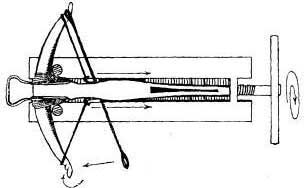 | 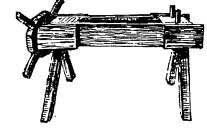 | 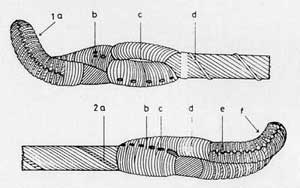 |
| Fitting the bowstring using a second "false" bowstring on a special bench | A bench with a screw spanner for fitting the bowstring | One variant of the bowstring ending. Simple loops were also commonly used, however. |
Powerful crossbows with a German or English cranequin are encountered in medieval paintings rather rarely. Most surviving German cranequins date only from the Renaissance, when strong steel bows became widespread.
The ordinary military crossbow was, in my opinion, a plain weapon without decoration. Although facing with bone plates increased the durability of the tiller, it seems that the reasons were mainly aesthetic. Collections hold mainly hunting or sporting examples faced with bone plates and with polychrome bows. In their day these were luxury weapons, and that is precisely why, unlike ordinary ones, they have survived to the present day.
 |  |
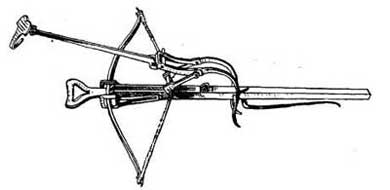 | 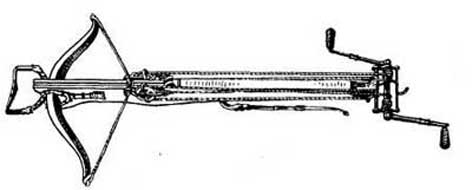 |
| Spanning hooks with pulleys. The fitting at the end was attached to a special pin on the crossbow tiller. | A windlass. Unlike the English cranequin, it has no pulleys. | A lever spanner working by pull. Together with the variant working by push, it is also called a "goat's foot". | An English cranequin. It had up to 6 pulleys and was not easy to handle. It was used here only exceptionally. |
Projectiles
The crossbow projectile, i.e. the bolt (in Old Czech "plitka" or "střiel"), consisted of a wooden shaft with two stabilising vanes and a forged point. The most commonly used were points of square or rhombic cross-section fitted to the shaft by means of a socket or a tang. Their shape was suitable for piercing protective armour, especially mail. Other types of projectile were used to a lesser extent. A winged point with long cutting edges was probably intended, given its great wounding power, mainly for shooting at horses. It was precisely by shooting at horses that confusion was brought into the charging cavalry. This was directly required by the military regulations of the time. For example Václav Vlček of Čenov: "And those shooters who will be behind the pavise-bearers, let them shoot the horses before the encounter and after the encounter".Points of other shapes occur exceptionally, e.g. with a forked body with two tips; a hollow point with holes that whistled in flight; a sickle-shaped point with the tips forward. The stabilising vanes were usually made of thin leather, wood or paper. Plundering soldiery (that is, any ordinary army) liked to use paper or parchment from looted books.
A special group consists of points with engraved decoration (finds from Plačice, Mnichovice, Mstěnice). These bolts are mostly marked with a monogram and are regarded rather as ceremonial objects or badges. Some find circumstances, however, attest that they were also used in combat (Plačice).
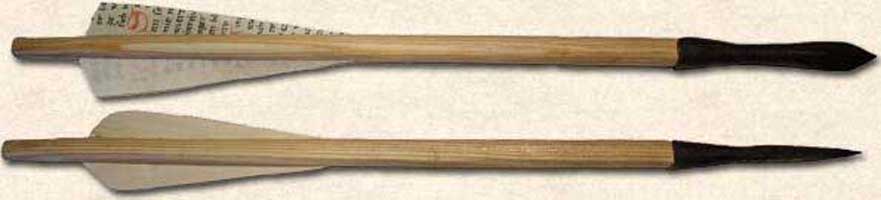 | 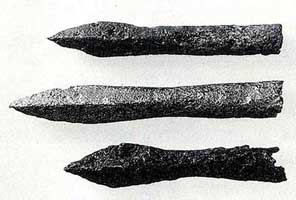 |
| Two classic "plitky" with armour-piercing points (Panzerstecher, bodkin) | Original points |
The accuracy of a standard medieval crossbow was not great. For war purposes, however, when the target was a man or a horse, it was certainly sufficient. When shooting replicas, one can see for oneself the great influence of the forged point on accuracy. The points are not entirely symmetrical and, despite the smith's efforts, differ in size and weight. A certain role is also played by the symmetry of the bow's spanning, which is not precise, especially when a belt hook is used. The properties of an authentic composite bow cannot be verified today, since the reconstruction of the original production technology has so far not been mastered satisfactorily.
The advantage of the crossbow over the bow is the aforementioned possibility of keeping a spanned weapon ready to fire at a moment's notice for a long time. This was certainly appreciated both by the warrior on the wagon fort and by the rider, who calmly spanned his crossbow and hung it from his saddle (which was certainly not without risk) so that he could then attack an opponent with it. A high rate of fire always brings with it the problem of ammunition supply, and the lower rate of fire of the crossbow was not seen as a major shortcoming given the tactics employed. This assumption is also confirmed by the unprecedented development of firearms and their eventual victory over mechanical missile weapons.
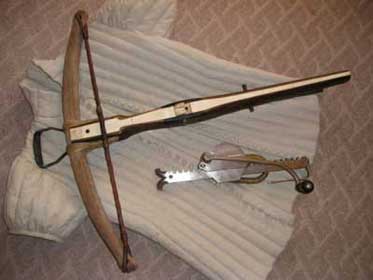 | 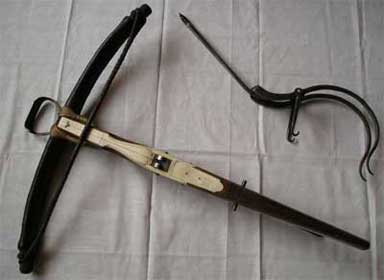 | 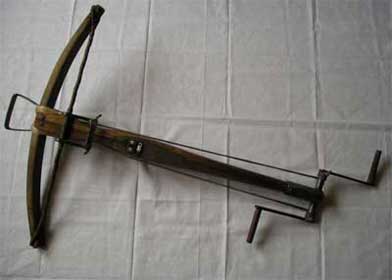 |
| Replica of a crossbow with a German cranequin | ... with a lever spanning device | ... with a windlass |
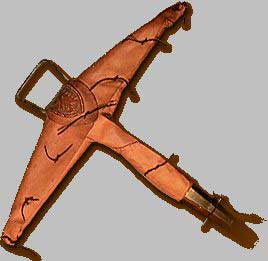 | 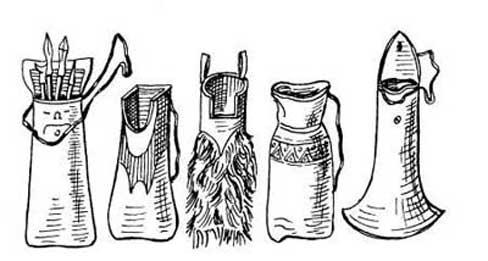 | |
| Transport cover to protect the crossbow from the weather | Various types of quivers. Wooden ones covered with leather or fur were common | |
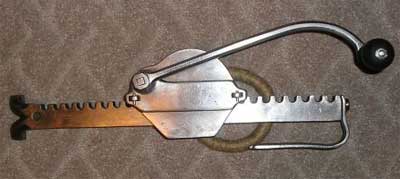 | 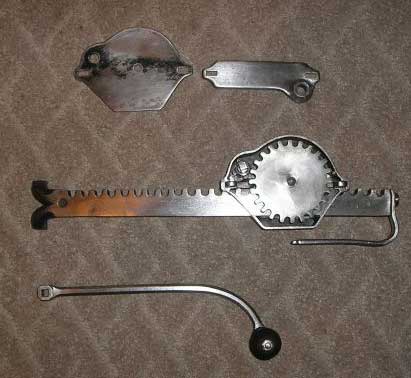 | 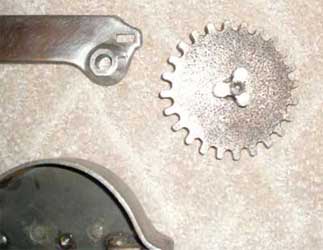 |
| Replica of a German cranequin | Components of the cranequin | Toothed wheel |
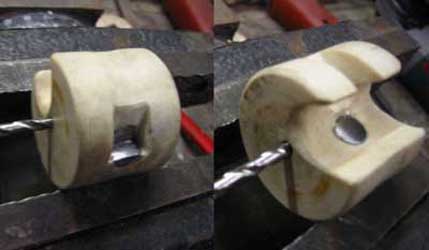 | 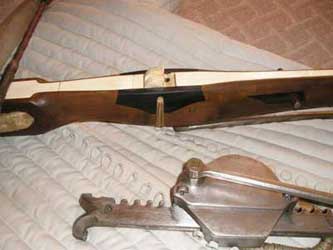 | 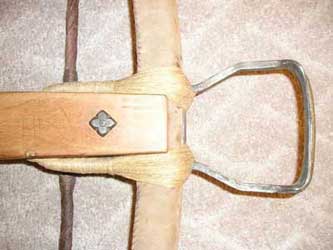 |
| Nut made of elk antler. The trigger rests against an iron pin. This is a simplified solution. Originals usually have a steel plate in the lower part, held by a riveted pin.. | The nut sits with minimal play in a metal seat and cannot fall out on its own. When the bowstring is drawn, its entire front face rests against this seat. | The front part of the stock is reinforced with a vertical pin, which prevents it from splitting. |