

Traditional Disciplines in England – Part 1. Introduction
Machine translation.
This page was machine-translated from Czech. The Czech version is authoritative.
Switch to original Czech version. · Zobrazit originál článku v češtině
A very interesting discussion about traditional English archery disciplines, such as Clout, has got under way in the discussion forum on the Lukostřelec.cz portal. Judging by the first responses from archers in the Czech Republic who practise traditional archery, we can expect that some of these disciplines will quickly become popular and that they will start training them next season (2007). We believe that as the popularity and awareness…
This introductory article was sent to us by Griffin, who sees it as his contribution to popularising these disciplines in Bohemia and Moravia. He also sends a message that we can all look forward to the sequels :o) In my article I draw on two publications with the same title, "Rules of Shooting" (Rules of shooting), issued independently of each other by two different organisations. The first was published by The Grand National Archery Society (hereinafter GNAS) and the second by The British Long-Bow Society (hereinafter BL-BS). The second publication was lent to me by Hawkwind, because nothing has yet arrived from BL-BS since I ordered it. My colleagues from BL-BS simply invited me to their tournaments, where I am to "collect" the rules in person.
Author's note: I would like to thank Hawkwind both for the loan and for his advice and comments. I hope he will gradually rejoin the discussions on the portal, at least on this topic, as he is one of the few people with practical experience of these disciplines. I would also welcome the experience of other archers who know something about these disciplines or have tried shooting them, so that they can share it with us in the discussion below the article.
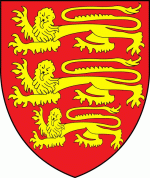
The official coat of arms of the Kingdom of England (Kindom of England) used in the period 1198 – 1340. You can learn more about the historical coats of arms of England here... |

The flag of England bore the red St George's cross on a white background. English longbowmen mostly wore it on their sleeves when fighting for the king. It is still part of the emblem of the Fraternity of St George, the organisation that runs tournaments with traditional longbows. |
Introduction
Writing about traditional archery disciplines in England is difficult, because all of them have a relatively traceable historical background, probably longer than in other European countries. I shall therefore focus only on those archery disciplines which, in my opinion, differ considerably from the disciplines known in other countries of the world. The only exception is Australia, where, thanks to earlier English influence, similar disciplines are found.
Over the course of several articles I shall describe the following traditional archery disciplines: Clout Shooting, Flight Shooting, Roving (Fixed Marks), Traditional Longbow Target Shooting, and finally I shall introduce you to a speciality called Popinjay Shooting.
Translator's notes: Where I consider a translation into Czech misleading, because I find it hard to come up with Czech equivalents, I give the original text in brackets.
Overall impression
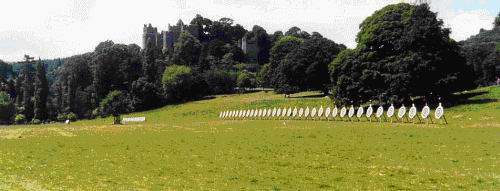
These English disciplines convey a deep tradition reaching back to the days when very powerful medieval war bows called longbows were used. Various sources state that the disciplines Clout and Roving (Fixed Marks) arose "naturally" as a result of the training and entertainment of archers who, on Sundays on their way to church, shot at various targets, e.g. trees, bushes, turfs, or a piece of cloth hung on a pole, and so on. The distances and angle of shooting used in these two disciplines clearly document the use of the bow as a weapon of war.
Traditional longbow target archery is shot at distances that can also be found in the FITA rounds. I include this discipline here because, once again, I sense a deep tradition in the names of the individual rounds, and also because, unlike the FITA rounds, it is standardly shot "on the islands" with the traditional bow as well.
What is shot
GNAS defines in its rules, as is usual in other countries, all types of bows quite precisely, from compound bows to the traditional longbow. For each discipline, the GNAS rules define the relevant bow categories from which these disciplines are shot at archery tournaments.
BL-BS lists only one category in its rules – Longbow.
Because the discussion on Lukostřelec.cz about these disciplines was prompted by traditional archers, I shall concentrate only on the longbow type of bow.
Definition of the longbow type of bow in use (abridged):
- The traditional longbow is made of wood, either from a single piece or composed of several layers of wood (either "self", "backed", or "laminated") with a convex "belly" (stacked belly) and horn tips (nocks).
- The length of the bow is at least 5 feet (approx. 155 cm) for arrows shorter than 27 inches (approx. 69 cm) and at least 5 feet 6 inches (approx. 170 cm) for arrows longer than 27 inches.
- The middle of the bow is its widest point; the depth/width ratio of the bow must be at least 5/8 – measured from the "back" to the "belly", and at every point of the bow. There must be no arrow rest (shelf) on the bow.
- Bows of which bamboo is a structural component are also permitted (author's note: presumably meaning the backing), provided they comply with the preceding rules.
- A bowstring of any material may be used with the bow, and it may have a "kisser".
Differences in the definition of the longbow according to the BL-BS rules:
- For safety reasons, bows with a full draw weight exceeding 70 pounds are not permitted for the Clout and target disciplines.
- Bows that have nocks for the bowstring directly in the tip of the bow (self nocks), i.e. bows without horn tips, are permitted only for the Flight and Roving disciplines.
Author's notes on the definition of the longbow:
- I asked the Fraternity of St. George, which organises tournaments together with BL-BS, how they enforce the obligation to use horn tips on the bow. They answered that, in principle, "self nocks" are by now quietly tolerated everywhere. In my view this is because bows without horn tips are more easily available to the great majority of archers.
- I also wondered what draw weight of bows these disciplines are actually shot with. According to their information, bows with an average full-draw weight of 50 lb are used (at least approx. 45 lb and at most 55 lb). Naturally, extremists have, e.g., 60 and 65 lb at full draw. Stronger bows are also used for the Flight discipline. Clout in effect means shooting 72 arrows at a distance of 165 m. You draw the bow as far as "it will go", and that is a relatively physically demanding business.
In target archery (the prestigious York Round) you shoot 72 arrows at 91 m, 48 arrows at 73 m and 24 arrows at 60 m. You may shoot it all day, but the question is how many times you are able to draw a heavier bow. This places great demands on the quality of the bow, not only in its draw weight but above all in the workmanship of the limbs, so that they have enough "whip" to give the arrow its initial speed. But please let the bow makers comment on that. - From the discussions I have also gathered that for these disciplines the English no longer really "play" at "war" bows with the longbow, and often also define this bow as a "19th-century recreational bow". This is probably because by then they had long since abandoned the idea of bows made from a single piece of wood and made at least a "backing" on the "belly", using exotic wood imported from the colonies for both – that is my speculation. These bows then probably equal the original yew bows – or surpass them.
- Discussions are also under way on the BL-BS website about the need to change the current definition of the longbow. From the discussions, however, it does not follow that a possible new definition of the longbow would bring any fundamental changes affecting the construction of these bows, e.g. that the disciplines would allow bows with "windows" (cut-out risers) or with an admixture of fibreglass laminate.
- Besides the rules above, there are also many other clarifying provisions, e.g. that the backing must not be more than 1/3, that the number of layers of wood and bamboo should be 3 to 6 for laminated bows, and so on.
- Instead of the term "stacked belly", the wording "a bow with a D-shaped profile" is also often used.
Arrows for traditional longbow disciplines
The arrows are wooden with fletching, the ends being made of horn, nock or plastic. The points must not exceed the diameter of the shaft at the place of attachment. No large point diameters may be used. For the "Flight" discipline an arrow longer than 28 inches is used. This discipline also uses the so-called standard arrow, which has exactly defined dimensions and weight.
Clout Shooting
The word allegedly comes from the Viking word "clud" or else from the word for fabric ("cloth"). Clout is shot according to the GNAS rules, but there are also FITA Clout and BL-BS Clout.
Target
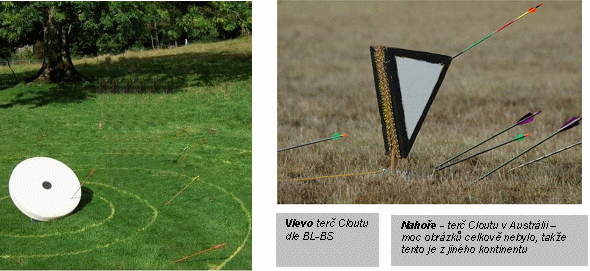
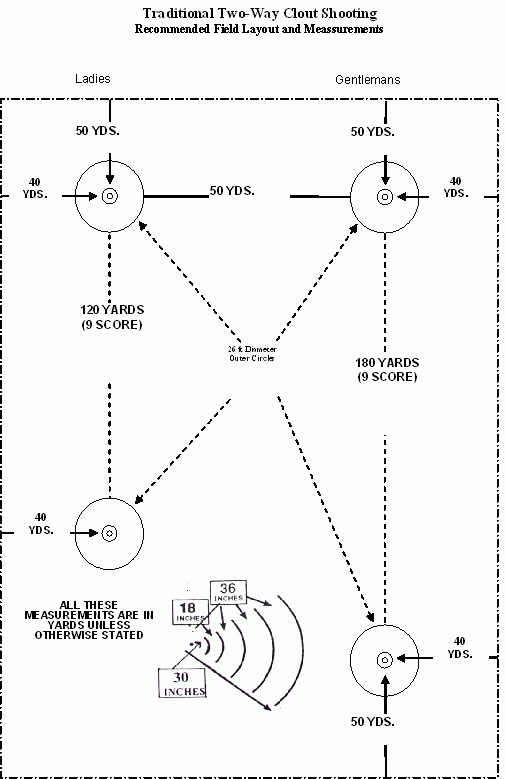
The target is usually concentric circles (five in all), the largest with a radius of 12–13 feet (3.7 – 4 m), marked out on the ground. The archer is thus aiming at a circle about 8 metres in diameter. At the centre of these circles a mark is placed – the Clout.
Scoring of the discipline
GNAS in fact has no target (it is a cloth attached to a pole). So the points awarded for the individual circles, going outwards from their centre, are: 5, 4, 3, 2, 1. 5 points are also counted for hitting the cloth.
BL-BS awards 6 points for hitting the target and the following points for hits in the individual circles marked on the ground: 5, 4, 3, 2, 1 (from the centre of the circles outwards).
Distances
How Clout is shot
Single-sided Clout is shot at one target placed at the relevant distance. A total of 36 arrows are shot at this target. Under the GNAS rules this is 6 ends of 6 arrows, under the BL-BS rules it is 12 ends of 3 arrows. Clout is shot by the whole group of archers at once. The archers stand in a line side by side and always shoot one end of arrows at one target. After they have shot the first end at it, they walk to the target, where they record the results achieved and pull out their arrows. They return and shoot the next end.
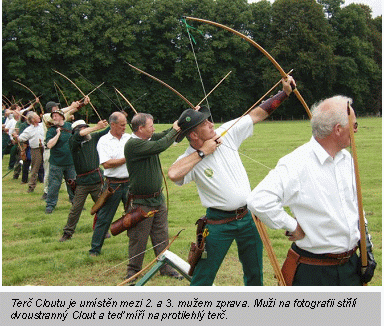
Double-sided Clout: Clout is usually shot as double-sided, at two targets standing opposite each other, the so-called Double Clout Round. In this Clout the archers shoot 36 arrows at each of the two targets. In total they therefore shoot 72 arrows. It is then shot in the same way as the single-sided version, with the difference that the archers do not walk back, but at the target from which they have pulled their arrows they line up again and shoot the next end at the opposite target. This method is advantageous given the distances at which Clout is shot. The archers thus do not have to walk back to the starting line "for nothing".
See the plan.
To be continued: Flight, Roving, Traditional target archery ...
Literature and images used:
[1] The Grand National Archery Society: Rules of shooting, April 2002
[2] The British Long-Bow Society: Rules of Shooting, Fifth Edition 2003
[3] Images: downloaded from the internet, from various archery clubs in England. The images are used in this article for non-commercial purposes with the aim of popularising this sport in the Czech lands
For your information: you can find the discussion about Clout on Lukostřelec.cz in the forum "Shooting disciplines / Clout".
Author: Griffin