

Transporting Arrows and Bows
Machine translation.
This page was machine-translated from Czech. The Czech version is authoritative.
Switch to original Czech version. · Zobrazit originál článku v češtině

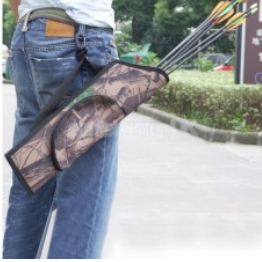
What led me to these thoughts was a picture of an archer circulating on the internet. I have a deep understanding for making multifunctional, flexible and Protean gadgets and cases, but it is certainly worth first considering what I want to carry and where, and what I want to protect it from. The impressive installation is a…
What led me to these thoughts was a picture of an archer circulating on the internet. I have a deep understanding for making multifunctional, flexible and Protean gadgets and cases, but it is certainly worth first considering what I want to carry and where, and what I want to protect it from.
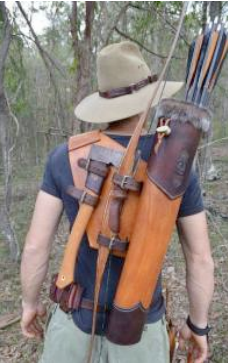
The impressive installation is greatly admired by non-archers. It devoured enough material for three quivers and is incredibly impractical. If the intended purpose was to free up the hands, I am afraid it is a very clumsy solution. Both the bow and the arrows will get in the way enormously during any activity. If the archer wants to use them, he has to take the whole outfit off, so the arrows might just as well have been in a closed tube, as is the case with modern archery backpacks, which are usually also fitted with a stool.
The Prague Větve are mostly 3D archers and at first their programme was the promotion of horse bows. The programme of "promoting traditional bows and archery" has hopefully stayed with them.
Most of us are primarily concerned with field shooting, one of us briefly dabbled in mounted archery and one devotes himself to Japanese archery. Now and then we also travel somewhere. Sometimes by car, sometimes by an overloaded car, sometimes by aeroplane……
For a long time I did not feel the need to use anything other than an ordinary quiver for travelling by car. But then a friend brought his girlfriend along to a competition. The girl had a huge rucksack full of girly necessities and was constantly searching in it for something urgent, rolling the rucksack all over the boot and my arrows. That taught me a lesson.
From the point of view of the specific requirements of the Větve, transport covers and equipment can be divided into:
- historically accurate (traditional) covers and carriers
- carrying covers (quivers)
- covers for transport (travel bags, cases, etc.)
- modern carriers
- carriers adapted to the specific requirements of a discipline, climatic conditions, etc.
These groups can of course overlap.
Transporting arrows – the quiver
The purpose of a quiver is both to carry arrows and to protect them. An archery quiver should have sufficient capacity for its purpose: a hunting one for a single arrow, one for indoor archery for three arrows, and so on.
With wooden arrows it is an advantage if the archer can pick a particular arrow, because arrows often have inconsistent properties.
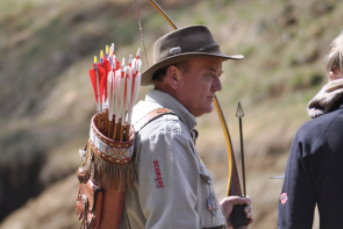
An arrow should be easy to take out. The archer should be able to reach it easily and the quiver should allow the hand a natural movement and easy removal – this is a problem especially with back quivers. With the archer in the first picture I do not really believe that he could take out an arrow without taking the whole set off his back, or without bending forward and spilling his arrows on the ground.
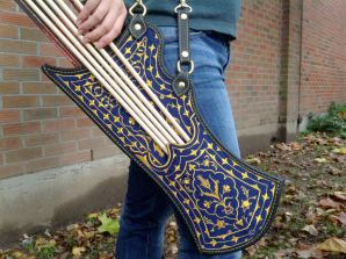
That is another important point – arrows should not fall out of the quiver by themselves at the slightest movement or when bending forward. With a horse quiver the arrows should stay in the quiver when mounting……incidentally, driving on the left and giving way to the left were introduced in road traffic precisely because of horses, since most people mount from the left. It is easier to mount from the pavement than from the road….. Traditional quivers solve this through their construction, the tightness of the pocket, a closed form, or padding. With a cylindrical quiver, a simple trick is to stick a toilet brush into it.
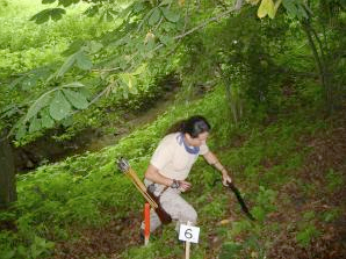
Since we are mainly concerned with 3D archery, many of us use side horse quivers as ready-to-hand quivers. Leaving the weather aside, the main requirements are that the arrows do not catch in the undergrowth when moving through the landscape, that they do not fall out when we have to bend down or jump off, and that we can choose an arrow according to courage and quality – personally, for "challenges" I prefer to use, cowardly, arrows to which I am not too emotionally attached. Of the traditional quivers, the Turkish quiver meets these requirements admirably.
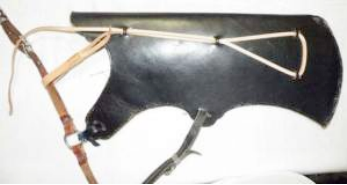
detail of the Turkish suspension
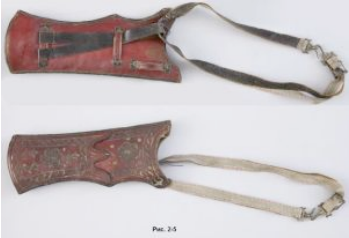
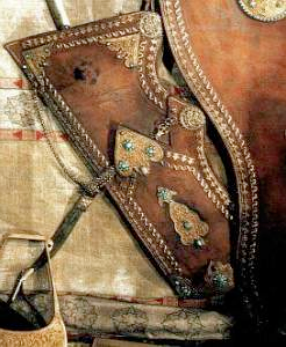
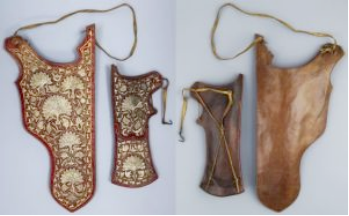
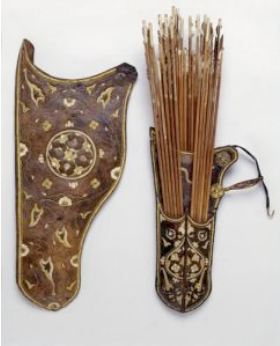
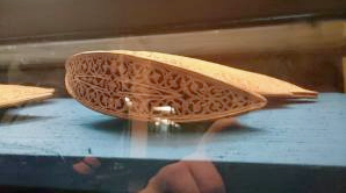
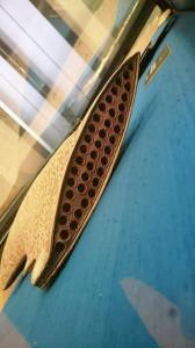
It usually has two pockets (allowing the arrows to be sorted), a fairly considerable carrying capacity and a three-point suspension. The archer has the fletching behind his back, that is, the other way round from most modern quivers. The arrow is taken out with a slight movement of the hand backwards and the construction of the quiver ensures that the arrows are held in it fairly firmly. Old quivers often had a wooden bottom.
Most East Asian quivers work on a similar principle.
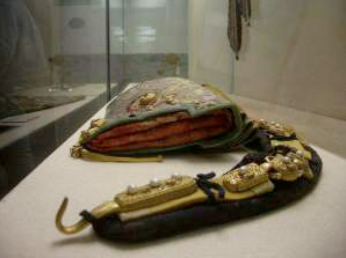
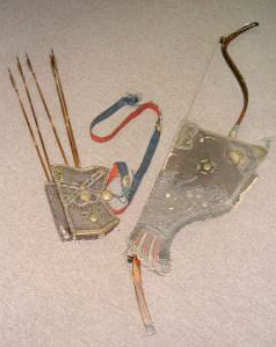
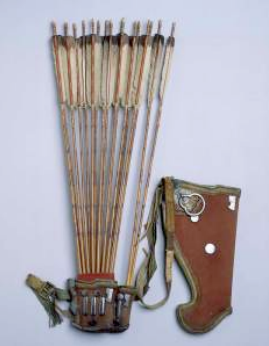
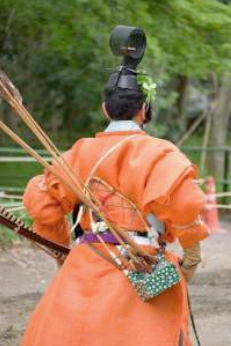
Modern pocket quivers also suit very well, but they have a small carrying capacity, so the archer has to carry spare ammunition in a transport quiver or box.
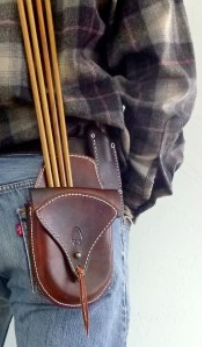
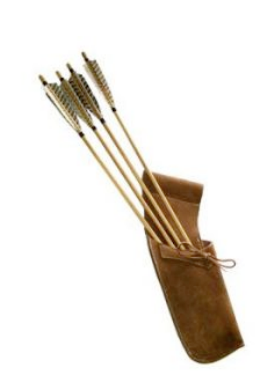
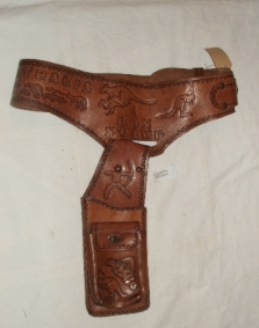
holster with belt, Simon collection, Manchester
Among archers shooting mainly indoor and classic target disciplines, side quivers hanging loose from the belt with the fletchings pointing forward are very popular. The archer does not move much, often sits on a chair and usually has plenty of room around him on the shooting line. He moves to the shooting position over grass or parquet, does not have to get through bushes and similar obstacles, and so it does not matter that the quiver swings in all directions and the arrows are stored in it very loosely.
Japanese quivers are rather unsuitable because it is hard to put arrows into them, but Japanese hunting quivers, on the other hand, protect arrows from the weather very well.
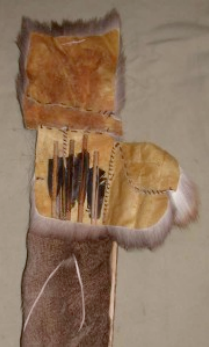
A fairly practical quiver was found among the equipment of the "Iceman" Ötzi
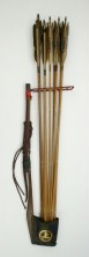
Many years ago, when I still shot "the League"……a long-term competition that then comprised three disciplines……I made my own version of the Japanese "shiko" quiver, because of the huge overvaluation of rapid-fire in the scoring. The quiver could be worn either in the same way as the "ebira" quiver, or hung on the belt by the upper hook with the "container" at my ankle. It allowed extremely fast drawing of arrows. Compared with the Turkish one, the quiver had a fairly small capacity.
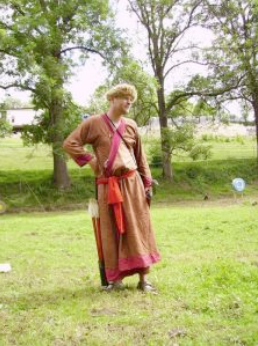
Back quivers are best hung with a three-point suspension, so that the archer can reach the arrow and also take it out of the quiver. By no means like the romantic in the first picture. The problem with them is that in the vast majority of cases they put design before function. Their construction does not sit firmly on the back and very often it is simply a decorative tube with a string. When the archer leans over, the arrows spill on the ground, and before the shot he fumbles behind his head for five minutes trying to find out where the arrows are now. A back quiver also does not allow the selection of a particular arrow. Back quivers are very popular among longbow archers, that is, probably the closest to the traditional archery category.
Hunting quivers primarily protect the fletching of the arrow. They start from the assumption that the hunter needs only one shot. Arrows are "loaded" into the quiver from the top and are ready for use. This is how, for example, Japanese hunting quivers work. Hunting quivers can also serve as transport quivers, especially if they have a rigid construction.
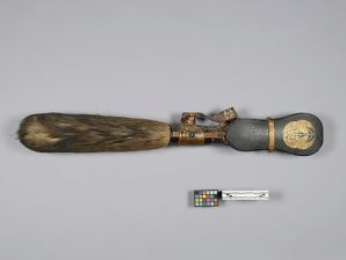
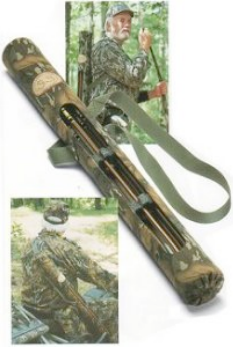
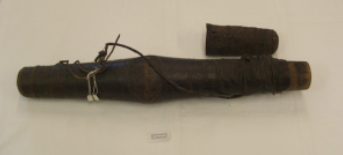
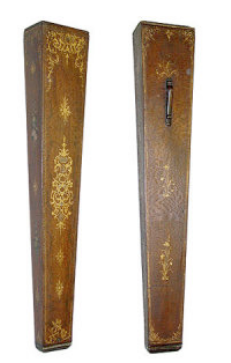
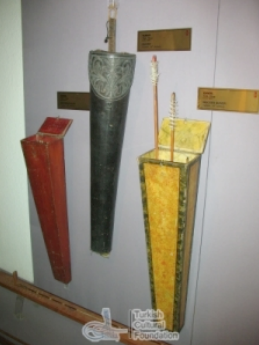
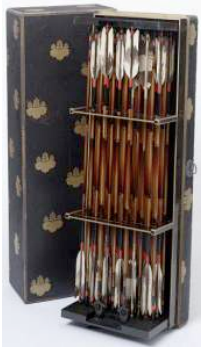
Transport quivers and arrow boxes are ordinary tubes or crates. A traditional representative of this category is the Turkish quiver for flight arrows. They were usually made as wooden, richly inlaid "kandili", or leather "kubur." Hunting quivers primarily protect the fletching of the arrow. They start from the assumption that the hunter needs only one shot. Arrows are "loaded" into the quiver from the top and are ready for use. This is how, for example, Japanese hunting quivers work. Hunting quivers can also serve as transport quivers, especially if they have a rigid construction.
Bow cases and covers
Their purpose is primarily to protect the bow during transport. Usually with the bowstring unstrung. The exceptions are horse bow cases – the sajdak and the gorytos. The sajdak is a case for the bow, while the gorytos is a case for the bow and arrows at the same time. It serves to free the rider's hands and the bow is kept in it in a strung state.
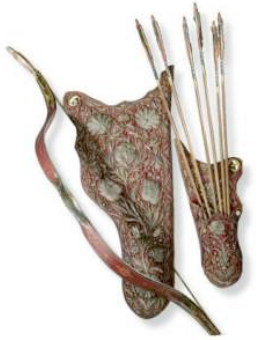
The trouble with the sajdak is that it is designed for a rider. So it is worn on the opposite side of the body from the arrow quiver. While walking it dangles about, and when shooting downhill the bow can catch on it.
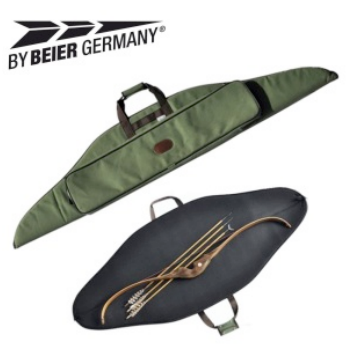
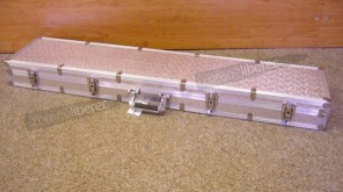
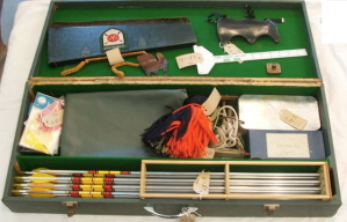
You find yourself in a quite specific situation if you travel by plane. Unless the passenger wants to pay extra, he is considerably limited in both the dimensions and the number of pieces of luggage. This is where special covers come in. It is possible to use an ordinary bow bag …..but I have seen how luggage is handled. The traveller usually hides the bow, arrows and often something extra in it. Gun transport cases work very well. That is, unless you have a long bow. My friend Jeneš in Paris, with a longbow, went off to pay 20 euros for oversize.
Author: Míša Sodja
Published with kind permission of: www.prazskevetve.cz