

Bow categories
Machine translation.
This page was machine-translated from Czech. The Czech version is authoritative.
Switch to original Czech version. · Zobrazit originál článku v češtině
This article describes the permitted equipment for the individual categories in competitions organised by the Czech Traditional Archery Association – Lukostřelec.cz, o.s. The rules are valid from 1 January 2011.
In competitions organised by the association ATL ČR we divide archers into three basic categories according to the equipment used. These categories are:
Primitive bow Traditional bow Barebow
You will find exact descriptions of the categories in this article. Our tournament rules merely refer to this article. To make clear which types of bows are meant in the descriptions, we have created a small photo gallery showing various types of bows and their classification within the categories. The gallery will gradually grow with further examples of bows and arrows.
The equipment used is checked at registration. If any part of the equipment does not correspond to the given category, the archer is automatically placed in a higher category (where possible) or is disqualified from the competition. If an archer is forced to change any part of the equipment during the competition (for example because of damage), the change must be approved by the head judge. Otherwise the archer may be disqualified from the competition.
1. Primitive bow
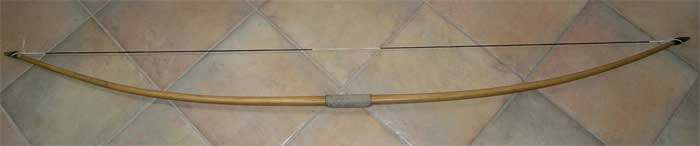
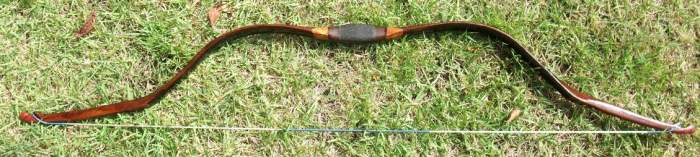
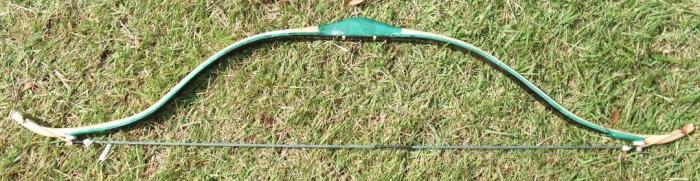
Bow: All bows made using original technology from natural materials. Modern adhesives are permitted to the extent necessary. Primitive bows are originals or replicas of bows used throughout human history, including the bows of present-day indigenous peoples, excluding bows of modern construction made from modern materials. Bows may be made from a single piece or assembled from various materials. In the case of doubtful construction, the archer is obliged to provide the sources from which the bowyer drew when making the bow.
Bowstring: A bowstring made from natural materials may be used. For safety reasons, however, a bowstring made from modern materials is also permitted.
Arrows: Only arrows with a shaft made of natural material (that is, mainly wooden, but also e.g. reed and the like). Target points and also forged "bodkin" type points are permitted, unless the tournament rules state otherwise. Fletchings may be natural only. Plastic nocks are not permitted. An exception is flu-flu arrows, which may have a plastic nock and need not have natural fletching. However, they may only be used in disciplines that expressly provide for the use of flu-flu arrows.
Examples of primitive bows |
 |
 |
 |
 |
 |
 |
2. Traditional bow
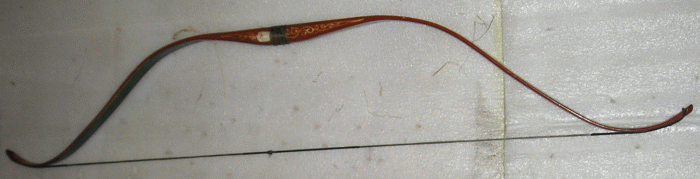
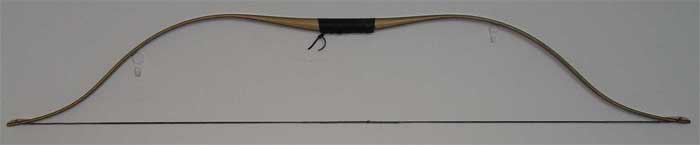
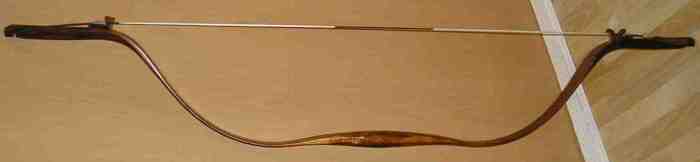
Bow: Only non-centre-shot bows (without a sight window). Traditional bows are copies in shape of primitive bows. The difference is the possibility of using modern materials in their manufacture. A simple arrow rest made of natural material may be used. This rest must be fixed and must not be adjustable.
Arrows: As for the primitive bow, but plastic nocks are also permitted.
Examples of traditional bows |
 |
 |
 |
 |
 |
3. Barebow
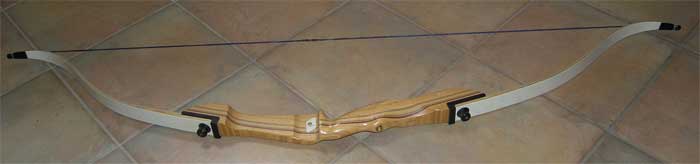
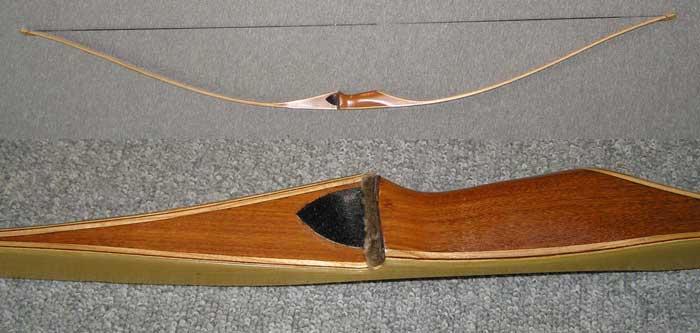
Bow: A bow of any type, provided it corresponds to the basic idea of a bow – that is, consisting of a grip without a sight window and two flexible limbs ending in a nock or tips for attaching the bowstring. The bow is ready for use when a single bowstring is stretched between the limbs, seated directly in the grooves at the ends of the limbs, and in use it is held in one hand by the grip while the fingers of the other hand draw, hold and release the bowstring. Multicoloured grips and manufacturer's marks placed on the inner side of the upper limb are permitted. The bow is made of one piece or of a grip and two separate limbs. The bow may have a centre-shot arrow pass through a sight window. An arrow rest made of any material may be used on the bow, whether adjustable or not.
Arrows: Arrows of any material. Target points. Natural or artificial fletching, nocks of any material.
Examples of barebows |
 |
 |
|

|
Restrictions for all categories
Bow: Bows must not have pulleys. Bow limbs must not be metal. No device for checking draw length may be used; stabilisers, compensators and sights are also not permitted. Buttons are not permitted. Any marks that make aiming easier are not permitted (with the exception of marking the place on the bow where the arrow is placed, if the bow has no arrow rest). An unstrung bow must be able to pass through a ring with a diameter of 12 cm.
Bowstring: A bowstring of any material and any number of strands of the same or different colours, with one or two loops by which the bowstring is seated in the grooves at the tips of the bow limbs. It may have a centre serving to protect the fingers. The serving of the bowstring must not end within the archer's field of vision at full draw. Under no circumstances may there be peep sights or any other devices or marks on the bowstring that help with aiming. A device for checking draw length against the nose or lips (kisser button) is not permitted.
Arrows: Cutting points must not be used.
Examples of permitted points |
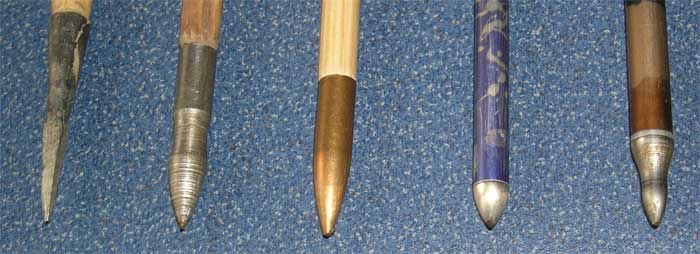 |
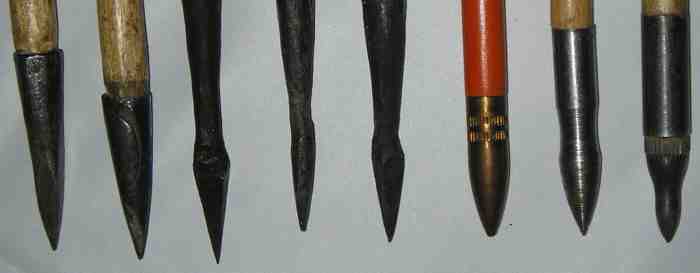 |
Examples of prohibited points |
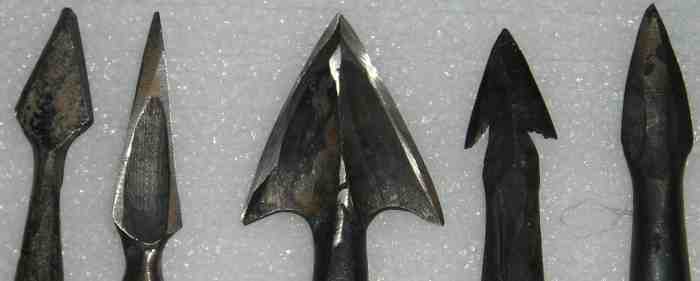 |
Method of shooting
It is possible to shoot using a shooting glove, finger tab, thumb ring, or bare fingers, in such a way that the archer must be in contact with the arrow with the thumb or two fingers, and in HL with at least one finger. String walking (moving the fingers along the bowstring) is prohibited in all categories.
Use of archery accessories
Archers are required to use a quiver or must carry their arrows, e.g. in the belt – it is not permitted to have arrows loosely laid out or stuck into the ground. Binoculars, telescopes or any optical aids for determining arrow hits and measuring distance must not be used unless expressly permitted in the description of the discipline. Shooting glasses are also not permitted. Overdraw aids are prohibited unless the tournament rules permit them. Releases are permitted only if historical and from the same era as the primitive bow.