

The Arrow and Archery of the Papuan Natives
Machine translation.
This page was machine-translated from Czech. The Czech version is authoritative.
Switch to original Czech version. · Zobrazit originál článku v češtině
Author: Jarda Zelenka - Zelí
My friend Tomáš Kotouč, a traveller and guide, recently returned from an expedition to the island of New Guinea. He brought me a wonderful gift: an arrow made by the indigenous Papuan people.
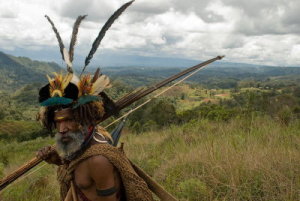
It is no souvenir made for tourists. Tomáš was away from the tourist areas, in mountain valleys where many tribes of primitive natives still live, as yet very little touched by civilisation. He visited the village of the Huli Wigmen tribe, where he spent several days. When he saw that none of the men left the village without a bow and arrows, he thought of me and bought an arrow from one of them.
It is a war arrow (wars between tribes are common and very frequent in this region) with a heavy point, intended for shooting at short range. The shaft is made of hard reed, into which a long, single-sided barbed point made of very hard palm wood is inserted. The joint is bound with thread made of plant fibres. The most interesting thing is that the arrow has no fletching at all. When I first saw it, I thought it was some old piece dug up from who knows where and that it had lost its feathers over time, but Tomáš immediately assured me that the arrow had been in use until recently and that everyone there has all their arrows without fletching. Another curiosity is that it has no nock with a notch for the bowstring (in fact it has no nock at all). As a bowstring they use a thin strip peeled from bamboo, about 8 mm wide, and the arrow simply rests butt-end against it.
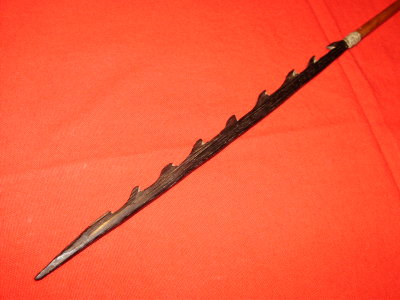
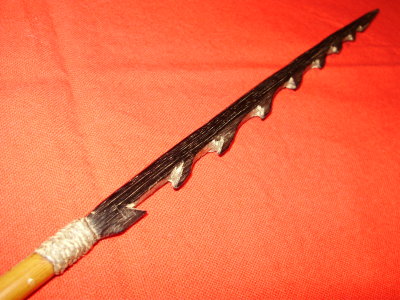
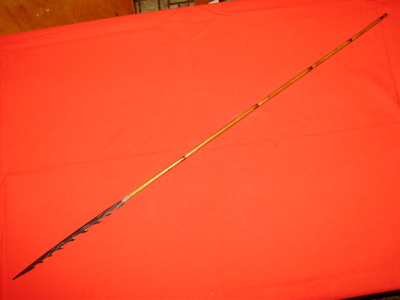
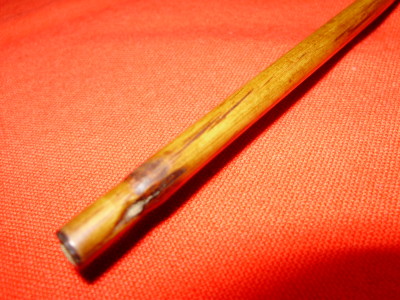
| Arrow specifications: | |
| overall length | 95.5 cm |
| shaft length | 69 cm |
| point length | 16.5 cm |
| diameter at the point | 8 mm |
| diameter at the nock end | 6.5-7 mm |
| total weight | 28 g |
| spine | 43 lbs |
| I found the balance point and calculated the weight of the shaft and the point (approximately, as I do not know how deeply it is inserted) | |
| shaft weight | 16.7 g |
| point weight | 11.3 g (173 grains) |
| The point is very heavy and the arrow has its balance point well forward | |
| FOC | 33.6 % |
Unfortunately I have only scant information about their bows and shooting style – Tomáš is not an archer, so it could not have occurred to him everything that would interest us.
Their bows are wooden, flat, about 150 cm long, with a flat bamboo bowstring. The bows reportedly show little care in their making; they are evidently a consumable item and it is no problem for them to make a new one often.
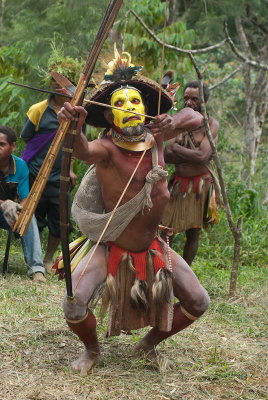
He saw them shooting and even had the chance to try shooting himself. He says he was unable to draw the bow fully. Given that he is not even an occasional archer, I would estimate the draw weight of the bow at 45-50 lbs. The shooting style is clearly visible in the photograph. The hand holding the bow also holds a supply of arrows, and the extended index finger serves as the arrow rest. The drawing hand has three fingers beneath the arrow, and the thumb holds the arrow on the bowstring (as I wrote, the arrows have no nock). Even though their arrows have no fletching, they reportedly shoot quite accurately. They demonstrated shooting at a reed stalk from about 10 m for Tomáš and hit it often.
The bow and arrow are for them chiefly a weapon of war; they do not hunt much, and when they do, they reportedly do not hunt for meat (they keep pigs) but shoot colourful birds for their feathers – the men there are great dandies.
They have two kinds of war arrows: for close range with a long heavy point, and for long range with a smaller, lighter one. Unfortunately we do not know where "close" ends or how far they can shoot at most.
Finally, one more curiosity. Among these people, killing a man is nothing out of the ordinary. Wars between tribes are frequent and the number of dead is reportedly sometimes as high as twenty. In the village of the Huli Wigmen, Tomáš spoke with several men and each claimed to have killed at least one enemy. But they reportedly treat travellers with respect (as long as you do nothing to wrong them).