

How I searched for the Lukostřelec.cz emblem in Westminster Abbey
Machine translation.
This page was machine-translated from Czech. The Czech version is authoritative.
Switch to original Czech version. · Zobrazit originál článku v češtině
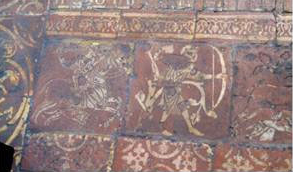
An adventurous and instructive search for the floor tile that served as the model for the archer logo.
Some time a year or so ago, I discovered the Lukostřelec.cz portal on the internet and gradually grew fond of it. The emblem, or rather the symbolism, of Lukostřelec.cz was not so clear-cut, however. At first I struggled to come to terms with the strange little black drawing of some archer, shooting an arrow through the lettering at a stag, oddly prancing about. What is more, that little figure always looked to me like a water goblin sitting in the tree in the background. That lasted until I came across the very same figure, again on the internet. Unfortunately I do not remember which website it was on, but I remembered that it was a medieval depiction of an archer found on some tile in Westminster Abbey in London. That caught my interest, and so my search began.
Humbly, I then took a closer look at the "water goblin" on the Lukostřelec.cz website, mentally apologised to its authors, and from then on regarded the design of the site with respect. I also told myself that the stag is nicely rendered there in the medieval spirit, and that it had been quite a good idea. Somehow it never occurred to me to ask the authors of the website how they had actually come up with the drawing. Not even when I won (2nd place behind Mýša!) a quiver with my now beloved "water goblin" at Lukohrátky.
This October my travels brought me to London for a short while, so I did not hesitate, sacrificed 10 pounds for the entrance fee and began looking for the tile in the Westminster Abbey complex, where photography was not allowed, which I had been intensively preparing for.
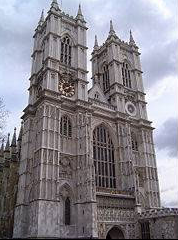
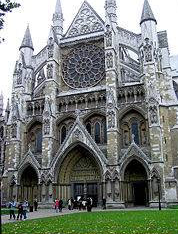
Westminster Abbey is one of the best-known buildings in Great Britain, where most English monarchs were crowned. With two exceptions (Edward V and Edward VIII), coronations have been held here since 1066. Or, more precisely – on this site. The oldest parts of this "national memorial" date from the 11th century, but not much of them has survived. The original form of the abbey, which William I the Conqueror had built here, has been preserved only in the famous Bayeux Tapestry. There is probably no point in recounting the history of this important building, which today is a Gothic cathedral whose buildings date mostly from the 13th century. If you want to know more about the abbey, I recommend the following links:
Westminster Abbey on the Czech Wikipedia
Westminster Abbey website (in English)
Back to my search. Since I did not know where the tile was located, whether it was a floor tile or a wall tile, or how big it was, I thoroughly went through the entire main nave. Then all the chapels and tombs – nothing anywhere. I slowly resigned myself to failure and, to put my conscience at rest, headed along the cloister towards the museum. On the way to the museum I was stopped by a turning to the Chapter House, which I did not know the meaning of (a chapter) and had not remembered from my previous visit to the abbey, so I went there. Already in the connecting passage I began to suspect that I was on the right track. I walked over tiles bearing little leaves, as if they had fallen from the quiver that Griffinka has carried since Lukohrátky.
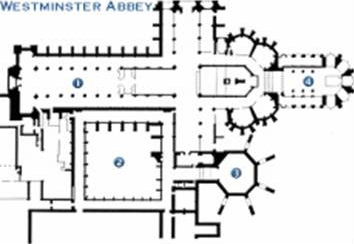
The Chapter House is an octagonal building from the mid-13th century (no. 3 on the plan). It contains the oldest surviving door in England (from the mid-11th century), a wall painting of the Apocalypse and probably the most extensive surviving medieval tiled floor. At first glance – the very tiles I was looking for. I was in the right place and now I knew what to look for – floor tiles, not wall tiles. I had no doubt that I would find the tile, so I calmly took in the sights and walked around the spacious room with my eyes glued to the floor. There were many tiles, some of them repeated – fish, leaves, coats of arms, even a foursome of griffins. But the archer was nowhere to be seen!! It already looked as though I would have to start pulling up the carpets, when next to a standing information board, right beside the "carpet runner", I saw the header of Lukostřelec.cz, set into the floor of the chapter house of the famous abbey.
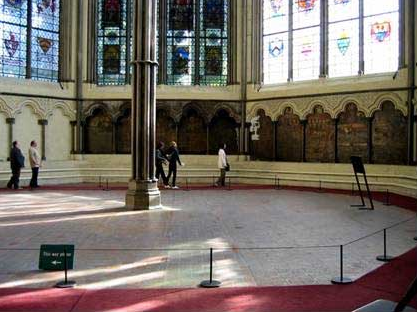
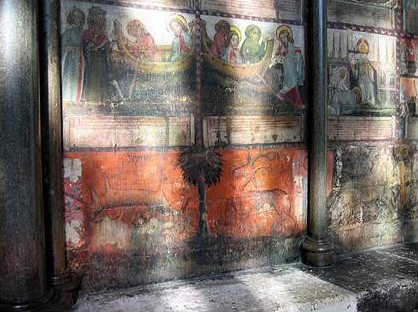
The tile with the archer is quite worn; it seems that it was heavily walked on in the past or damaged by a stand. I found only two such tiles on the whole vast floor! The tile with the archer is set in the middle of a series of three tiles that is repeated twice: a rider, an archer (hunter) and a stag. It is clearly a hunting scene.
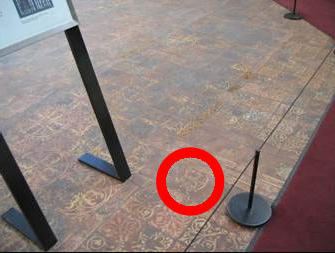
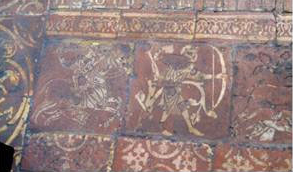
To get to the second pair, I eventually had to pull the carpet back after all and check whether there were any more archers there. There are not.
So I confirm the following: the Lukostřelec.cz emblem is taken from a tile in Westminster Abbey in London. The archer is fairly accurate, the stag is a free variation; the original looks a little different. (Editor's note: The stag is also taken from the original and graphically adapted. The hound clawing at it and the arrow in the stag's neck have disappeared, so that the logo does not look too "drastic" at first glance. Minor differences can also be found in the archer himself – the motif was adjusted so that it would look good in an inverted pure black-and-white display.)
There are only two such tiles in the whole abbey today – or I did not find any more. The truth is that the carpets cover a fairly large area and not all of them can be pulled back! Both tiles are quite badly damaged, so I recommend that all friends of Lukostřelec.cz and of history visit Westminster Abbey as soon as possible, before those two tiles are completely worn away by footsteps. I covered the second archer with the carpet again.
Before I forget, there is a fairly extensive text about the tiled floor, from which I took the series of black reproductions of the tiles.
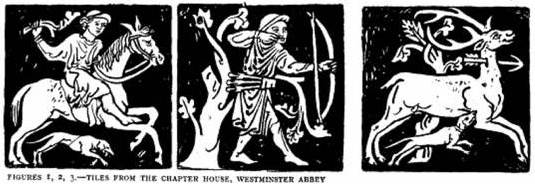
W. R. Lethaby The Burlington Magazine for Connoisseurs, Vol. 30, No. 169 (Apr., 1917), pp. 133-135+137-140