

Traditional Disciplines in England, Part II. Flight Shooting, Roving Marks
Machine translation.
This page was machine-translated from Czech. The Czech version is authoritative.
Switch to original Czech version. · Zobrazit originál článku v češtině
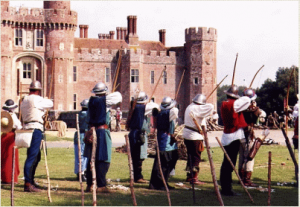
The second instalment of our description of English traditional disciplines is based on the Rules of Shooting issued by The Grand National Archery Society (hereafter GNAS) and The British Long-Bow Society (hereafter BL-BS). The article was sent to us by Griffin. Whereas GNAS is the umbrella organisation for archery sports in Great Britain and Northern Ireland, …
The second instalment of our description of English traditional disciplines is based on the Rules of Shooting issued by The Grand National Archery Society (hereafter GNAS) and The British Long-Bow Society (hereafter BL-BS).
The article was sent to us by Griffin
Whereas GNAS is the umbrella organisation for archery sports in Great Britain and Northern Ireland, BL-BS is a narrowly specialised organisation that confines itself to a single type of bow – the longbow, which is defined quite precisely (see the previous article).
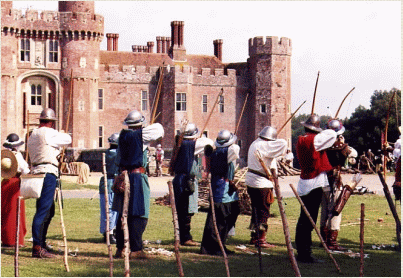
Both organisations are united by a deep respect for the tradition of the English longbow and its most famous period, which was without doubt the era of the Hundred Years' War (the 14th to 15th centuries), when, for example, at the Battle of Crécy (known in the Czech lands as "u Kresčaku") in 1346 an English army several times smaller (about 12,000 men) defeated the French army (30,000–40,000 men), chiefly thanks to the deployment of archers with longbows. The English achieved a similar result at the later Battle of Agincourt (1415).
Flight shooting
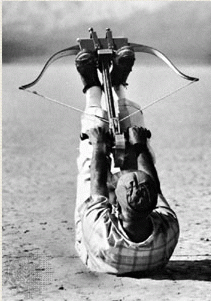
The name of the discipline can be loosely translated into Czech as "střelba na dálku" or "střelba na největší dolet" (long-distance shooting, or shooting for maximum range). The essence of the discipline is simple: whoever shoots the farthest wins. What do the rules say? First of all, how to hold the bow. Both the GNAS and BL-BS rules state that the bow must be held exclusively in the hand. In other countries where this discipline is also popular (especially Turkey), there is also a "free" discipline in which the archer may hold the bow (or rather the device) in any way.
The rules of the discipline also divide bows into individual categories. There is even a special category for "flight bows", which are specially constructed for this discipline. According to the GNAS rules, bows are divided into: recurve target bow, standard flight bow, compound target bow, compound flight bow, crossbow and longbow. The BL-BS rules have only one category: longbow.
In this discipline, bows are divided according to draw weight:
- all bows (except compound bows): up to 35 lb, up to 50 lb and without limit (Unlimited)
- compound bows: up to 45 lb and up to 65 lb
- crossbows: up to 95 lb
Want to know more? http://www.longbow-archers.com/flight.htm
How this discipline is shot
- GNAS rules: Six arrows are shot per end. A minimum of one end and a maximum of 4 ends. The archers stand in a line, at least 6 feet apart. If anyone shoots more arrows, the arrows that landed farthest are removed from the scoring. Each archer has their arrows signed, with a unique number marked on them.
- BL-BS rules: Only 3 arrows are shot per end, and only 2 arrows with the standard arrow.
Any man who shoots beyond 140 yards (128 m) with the standard arrow receives a diploma at the tournament. Women receive a diploma when they shoot beyond 100 yards (91.5 m).
What do the BL-BS rules designate as the standard arrow?
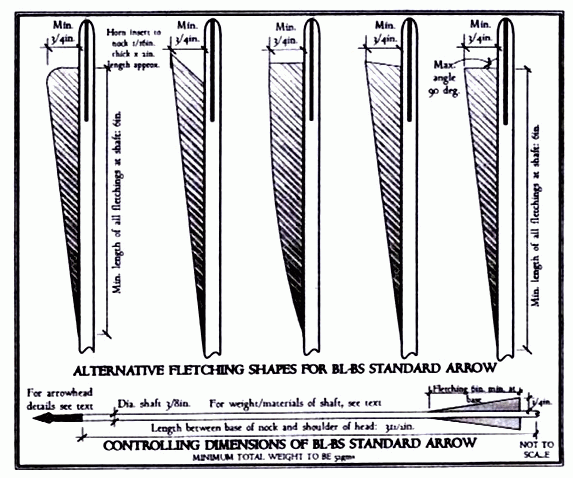
The standard arrow is the name for a type of arrow that appears only in the BL-BS rules. The rules distinguish two versions of the Flight Shooting discipline: with any arrow and with the standard arrow.
The standard arrow is then defined as follows:
- shaft diameter = 3/8 inch, made of ash or wood of similar density and elasticity,
- length 31.5 inches between the nock and the seating of the head – approx. 80 cm,
- the nock is cut into the body of the arrow and reinforced with horn (author's note: the arrow is cut, a slice of horn is inserted to fill the cut, and only then is the nock for the bowstring made at right angles to this slice),
- the minimum total weight of the arrow including the head and fletching is 52 grams or 802 grains.
The notes to the rules further state that a 3/8-inch cedar shaft of the appropriate length weighs only 28 grams, compared with 44 grams for one made of ash. If someone wants to use cedar, they must therefore make up the weight with the head and fletching. Each archer chooses the heads (arrow points) at their own discretion (bodkin, etc.). In principle, types are recommended with weights ranging from 16 to 28 grams according to the size of the head.
Anything to add?
You will find a discussion on the topic "What affects the range of an arrow?" on Lukostřelec.cz here ....
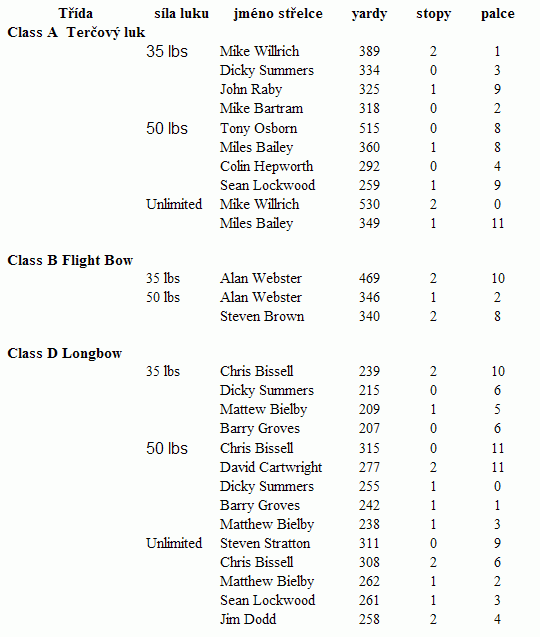
Results of the GNAS tournament – National Flight Championships, 19 August 2006, RAF Church Fenton (only selected categories are given).
According to GNAS, 1 yard = 0.914 m.
FITA World Records
English Longbow Gents N/E 35lb Chris Bissell 219.32 metres
English Longbow Gents N/E 50lb Chris Bissell 288.18 metres
What is Clouth of Gold
A special long-distance discipline is "Clouth of Gold", which is shot at a distance of 240 yards (220 m). The discipline is named in memory of the demonstration by King Henry VIII, who showed off his shooting to the French king on the field of the same name (Clouth of Gold) near Guînes in northern France. This distance is very close to the maximum range of the longbow and thus to safe clearance distances. The Fraternity of St. George always shoots at least one discipline at this distance.
Roving Marks
This is probably the oldest English discipline of all, and it can be translated into Czech as "Cesta po značkách" or "Střelba na značky" (Journey by Marks, or Shooting at Marks).
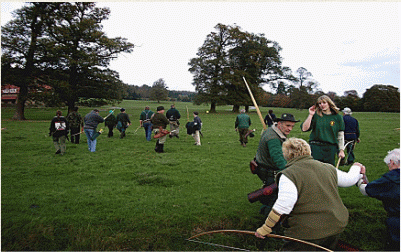
The discipline has the same history as Clout. Archers amuse themselves along the way and shoot at various targets. Unlike Clout, it is not shooting "there and back" but at various marks placed at different distances and in different directions. A group of archers shoots at one mark, walks over to collect the arrows, and from there shoots at the next mark. The word "roving" does not mean precisely walking but rather "wandering" among the marks, i.e. from mark to mark. Nowadays a mark is a pole about 2 m tall with some colourful and clearly visible symbol placed at its top. In BL-BS disciplines the mark derives from a historical tradition dating back to the Middle Ages. The poles may also be marked only with numbers.
Distances between marks range from 120 yards (approx. 110 m) up to 220 yards (201 m). The exception is marks placed behind trees, where the distance may be shorter. The angle of elevation of the bow and the trajectory of the arrow range from a raising to 45 degrees up to an angle of 80 degrees over a line of trees to a mark at a distance of "only" 80 yards (70 m). No measuring aids or marks on the bow are permitted.
- Want to know more about Roving Marks? http://www.longbow-archers.com/rovingmark.htm
- Want to know more about Clout? http://www.longbow-archers.com/clout.htm
How are these disciplines shot?
Traditional Roving in BL-BS:
The archers stand in a line around the mark, facing the mark they will shoot at. Nobody may shoot over the head of another competitor. Shooting is commanded by the "captain of the mark". Two arrows are shot. The second arrow may be shot only once everyone has shot their first arrow. After shooting, the archers walk to the mark that was shot at. The archer whose arrow is nearest the mark has won that mark and decides which mark will be shot at next from there. The competition ends when one of the archers wins 7 marks. Author's note: it is essentially golf with a bow and arrows.
Modern BL-BS method:
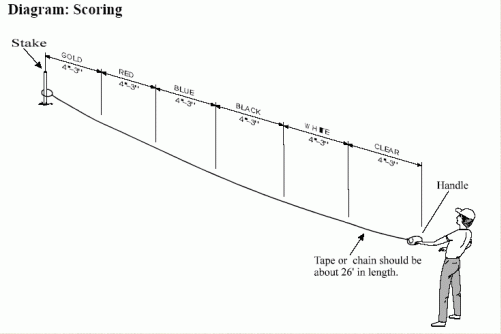
The archers walk round the marks in a predetermined order. 3 arrows are shot from each mark. Hits at certain distances from the mark are scored. Within half a bow's length = 12 points, within the length of one bow = 7 points, within the length of 2 bows = 3 points. Anyone who hits the mark itself = 20 points. The archers shoot at all the marks and then the points are totalled.
To measure the distance of the shot arrows from the mark, a tape with colour-coded distances is used. The following picture shows a similar tape, which is used in the Clout discipline. The tape shows the radii of the individual circles marked around the Clout target. This measuring tape considerably simplifies the preparation and evaluation of these disciplines, because concentric circles do not have to be marked around each target. It is enough simply to set up a mark and measure the distance of the embedded arrows from the mark with this tape.
Besides Roving Marks, this discipline is also referred to as Fixed Marks. It is said that from the 16th century there was in fact not as much free space for "Roving", and so shooting took place rather in designated open areas called "Fields". Well-known examples are Finsbury Fields, Moorfields and Spitalfields, where target marks were fixed to permanent stone posts.
Literature and images used:
The Grand National Archery Society: Rules of shooting, April 2002
The British Long-Bow Society: Rules of Shooting, Fifth Edition 2003
Images: downloaded from the internet, from various archery clubs in England, used for non-commercial purposes in order to popularise this sport in the Czech Republic
Author: Griffin